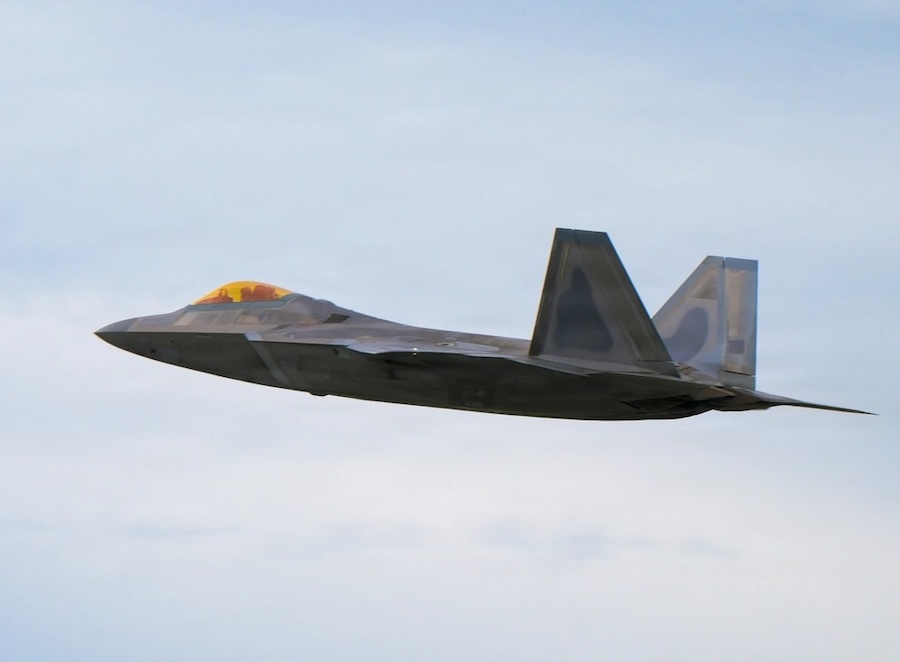
F-35C Lightning II and F-22 Raptor fighters demonstrate air dominance against simulated peer threats and complex air defenses at Red Flag-Alaska
.S. Marine Corps F-35C Lightning II fighters and U.S. Air Force F-22 Raptors operated together against complex air-defense threats during Red Flag-Alaska 26-3.
By Hannah Miller (Defence Industry Europe)
Photo: U.S. Air Force.
U.S. Marine Corps F-35C Lightning II fighters and U.S. Air Force F-22 Raptors operated together against complex air-defense threats during Red Flag-Alaska 26-3. The Aug. 14-18 training was the third and final iteration of the event in 2026.
The F-35Cs came from Marine Fighter Attack Squadron 251 at Marine Corps Air Station Cherry Point, North Carolina. F-22s from the Air Force’s 3rd Wing at Joint Base Elmendorf-Richardson, Alaska, provided the other fighter element.
E-3 Sentry aircraft operated by the 961st Airborne Air Control Squadron at Kadena Air Base, Japan, also participated. Their presence added airborne command-and-control capability to the joint fighter operations.
Red Flag-Alaska 26-3 was designated a Special Technical Operation flag, allowing forces to synchronize capabilities across air, space and cyberspace. The scenarios introduced operational disruptions intended to replicate conditions associated with peer and near-peer adversaries.
“We focus on integrating STO effects into the battlespace to provide realistic degradations that our forces can expect to see in a peer and near-peer conflict,” said U.S. Air Force Capt. Jason Bentley, 354th Operation Group Detachment 1 Red Flag 26-3 team lead. “For example, we leverage non-kinetic effects, which are military or strategic actions that achieve goals without using physical destruction or traditional explosive force that disrupt and complicate coordination for our forces.”
Participants practiced coordinating joint and coalition operations against complex air-defense systems. They also combined a broad range of effects to overcome those threats in a contested environment.
“Working with the Air Force during this exercise has been a great opportunity to learn from each other and see how different teams approach the same challenges,” said U.S. Marine Corps 1st Lt. Phil English, an F-35C pilot assigned to VMFA-251. “We’ve been able to talk through different exercise scenarios, share our experiences and learn what works well from one another.”
The Joint Pacific Alaska Range Complex provided 120,000 square miles of airspace for the training, with primary operations based at Eielson Air Force Base and Joint Base Elmendorf-Richardson. The range allowed participants to progress from individual skills to complex, large-scale engagements.
Red Flag-Alaska is sponsored annually by Pacific Air Forces and has a long history of allied and partner participation. The training is intended to exchange tactics and procedures, improve interoperability and support layered operations for homeland defense and power projection.
Air and missile defence
TKMS CEO says F127 frigate is designed to intercept ballistic missiles beyond Earth’s atmosphere, first ship possible by mid-2030s
AeroVironment lands $464.8 million U.S. Army order for dozens of LOCUST X3 laser weapons in directed-energy production first
New Sky Defenders documentary takes viewers inside NASAMS and the race to stop missiles and drones on NATO’s eastern flank and in Ukraine
U.S. Department of War signs seven-year deals with General Dynamics and Lockheed Martin to triple PAC-3 MSE and quadruple THAAD interceptor production
Latest News
U.S. Air Force’s first Kadena-bound F-15EX Eagle II leaves Boeing ahead of fiscal 2027 Japan deployment to replace legacy F-15C/D fleet
The first F-15EX Eagle II designated for Kadena Air Base departed Boeing’s St Louis facility on 28 August 2026, taking the US Air Force closer to permanently stationing its newest Eagle variant in Japan.
Britain targets threefold increase in Army strike reach through PrSM, alongside £590 million long-range rocket artillery programme
Britain will invest a combined £780 million in the Precision Strike Missile programme and long-range rocket artillery, placing extended-range firepower at the centre of its effort to rebuild the Army for NATO warfighting.
TKMS CEO says F127 frigate is designed to intercept ballistic missiles beyond Earth’s atmosphere, first ship possible by mid-2030s
TKMS has advanced the design of Germany’s planned F127 air-defence frigate, a warship intended to intercept ballistic missiles beyond the Earth’s atmosphere.
Hanwha sets out next K9 evolution at Estonia’s K9 User Club with fire-guidance drones, wheeled artillery and predictive logistics
Hanwha Aerospace has set out plans to expand the K9 beyond its traditional role as a tracked self-propelled howitzer.
BAE Systems Australia returns HMAS Hobart to water after major refit ahead of Aegis Baseline 9, Tomahawk and Naval Strike Missile integration
HMAS Hobart has returned to the water after a year-long refit, moving Australia’s first Hobart-class destroyer into the systems-integration phase of a major capability upgrade.
AeroVironment lands $464.8 million U.S. Army order for dozens of LOCUST X3 laser weapons in directed-energy production first
The U.S. Army has awarded AeroVironment a $464.8 million contract to produce and deliver dozens of LOCUST X3 high-energy laser systems.
Roketsan’s Çakır cruise missile scores direct hits on land and maritime targets in first trials from mobile ground launcher
Roketsan has completed the first firings of its Çakır cruise missile from a mobile ground launcher, demonstrating a second launch configuration for the modular weapon.
Thales, Kongsberg deploy Australian-built StrikeMaster with Naval Strike Missile for NATO’s Arctic Sentry deterrence activity
The Australian-built StrikeMaster coastal defence system has been deployed to Norway’s Jan Mayen island during a NATO training activity in Northern Europe.
Saab equips Royal Air Force with Giraffe 1X radars for deployed counter-drone operations amid rising threats to UK and coalition forces
Saab UK has delivered Giraffe 1X radar systems to the Royal Air Force under an urgent requirement for counter-drone operations.
Ukraine’s defence ministry says deep strike campaign hit 12 Russian oil refineries and two defence plants in August, reaching 1,900 kilometres from the border
Ukraine pressed its deep strike campaign against Russia in August, hitting energy and defence industry targets as far as 1,900 kilometres from the state border.
Palantir, Anduril win U.S. Army awards to begin production of eight AI-enabled TITAN battlefield targeting ground stations
The U.S. Army has ordered eight AI-enabled TITAN ground stations from a team led by Palantir Technologies, moving the deep-sensing program from prototyping into production.
New Sky Defenders documentary takes viewers inside NASAMS and the race to stop missiles and drones on NATO’s eastern flank and in Ukraine
A new documentary examining the NASAMS air defence system and the race to intercept missiles and drones will launch globally on Apple TV and Amazon Prime on 4 September.